
Omar Al Subaie, Performing Govt Director of Freight Providers at Etihad Rail, mentioned: “For heavy industries, logistics is now not measured by velocity alone — reliability has turn into a key think about operational success. Delays, congestion, and inconsistent efficiency drive up working prices. Rail freight presents a sensible resolution to those challenges, delivering operational effectivity, excessive reliability, and predictability, guaranteeing sustainable and constant efficiency day after day.”
Freight and bulk cargo transport
Al Subaie added: “Whereas rail transport performs a significant function in transferring items and bulk supplies of all types over lengthy distances — serving to cut back highway congestion and enabling vans to function extra effectively inside their optimum scope — different land transport modes will proceed to be needed, notably for last-mile and short-distance deliveries. This integration will improve the general efficiency of the UAE’s transport ecosystem.”
He continued: “The UAE has invested in a nationwide railway community designed to help the nation’s development for many years to return, not simply the brief time period. By means of this marketing campaign, we purpose to make sure that your entire industrial sector advantages from this funding. Rail freight is environment friendly, dependable, and able to scale.”
Stabilising transport prices
The marketing campaign highlights the lively function of rail freight in enabling corporations — particularly early adopters — to stabilize transport prices, cut back security inventory ranges, and plan manufacturing with higher confidence. This improves operational reliability and permits corporations to scale with out inserting extra stress on highway networks, a profit that turns into much more vital as manufacturing volumes develop. Etihad Rail Freight Providers affirms that the marketing campaign primarily seeks to rebalance the logistics system throughout numerous land transport modes in a means that serves the nationwide transport sector.
Linking Abu Dhabi’s ICAD industrial space to the Nationwide Rail Community
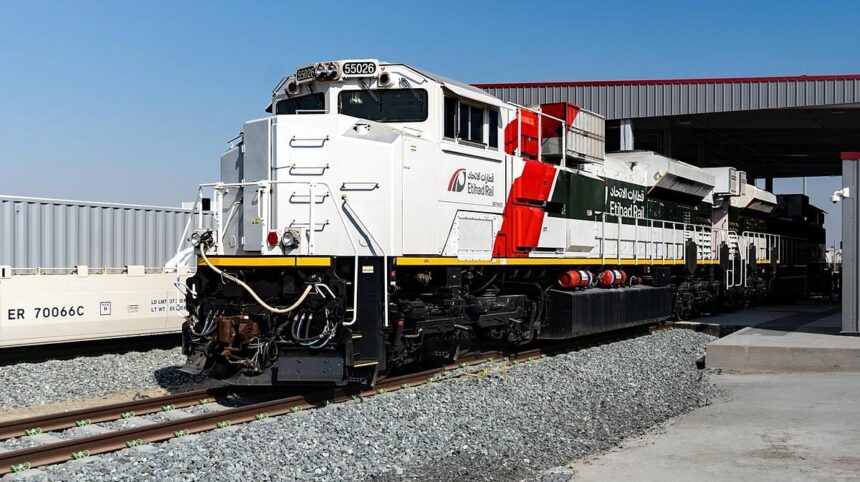
Etihad Rail, the developer and operator of the UAE’s nationwide railway community, introduced the completion of linking the Abu Dhabi Industrial Metropolis (ICAD) rail freight terminal — the biggest rail freight station within the nation — to the UAE nationwide railway community. The corporate has finalized laying tracks alongside the route extending from the UAE–Saudi Arabia border to Fujairah Port on the japanese coast, passing by way of key cities, industrial hubs, and industrial facilities.
Completion of Bridges and intersections with the Ghuwaifat Worldwide Freeway
The connection was accomplished by way of the development of railway bridges intersecting with the Ghuwaifat Worldwide Freeway, set up of rail tracks, and profitable testing of the brand new route. This achievement aligns with the targets of the Nationwide Rail Programme — the biggest land transport system of its sort throughout the Emirates — geared toward connecting the nation’s cities by rail and accelerating complete growth.
Upon completion and operation of Part Two of the Etihad Rail venture, freight trains will present logistical help companies from the ICAD rail freight terminal within the coronary heart of Abu Dhabi’s industrial zone, a key hub for industrial corporations within the area.
Supporting logistics operations by linking Abu Dhabi to industrial facilities
Mohammed Al Marzouqi, Govt Director of the Rail Affairs Sector at Etihad Rail, mentioned: “The completion of the route linking the ICAD rail freight terminal with the Etihad Rail mainline locations us in a state of readiness to start offering logistical help to our prospects by connecting the capital, Abu Dhabi, with numerous industrial facilities and export factors throughout the nation. This marks one other distinctive step towards delivering an built-in transport community that connects industrial and manufacturing facilities — inside and outdoors industrial zones — with freight terminals and ports throughout the UAE. It represents a qualitative leap within the transport ecosystem, reflecting ICAD’s strategic location and its integration with the biggest inland rail freight terminal within the nation.”
He added: “We’re happy with this achievement, which helps our efforts to encourage corporations to restructure their logistics operations and profit from rail by decreasing prices, enhancing effectivity, and transporting items extra safely. That is mirrored in industrial agreements signed with main corporations within the UAE reminiscent of Stevin Rock, Western Bainoona Group, and Al Ghurair Iron & Metal. These developments will positively impression finish customers, cut back stress on roads and upkeep prices, preserve tempo with the nation’s sustainable financial development throughout sectors, and create promising financial alternatives in trade, commerce, the surroundings, and past.”
The biggest inland rail freight terminal within the UAE
Etihad Rail is creating the biggest inland rail freight terminal within the nation at Abu Dhabi Industrial Metropolis (ICAD), spanning greater than 2.7 million sq. ft. The ability will embody over 22 operational help buildings and deal with roughly 9 trains per day.
The terminal will facilitate the motion and distribution of products throughout the UAE and GCC nations, linking quarries in northern Emirates with industrial facilities in Mussafah, in addition to connecting Ruwais and Khalifa Port, and container dealing with corporations in Dubai’s Jebel Ali Port.
The freight terminal will function a logistics companies hub for heavy industries, guaranteeing the sleek supply of uncooked supplies and equipment to producers, whereas facilitating entry to core commerce infrastructure reminiscent of ports. The ability can even present customs companies, enhancing the competitiveness of tenants in Abu Dhabi Industrial Metropolis (ICAD).
Working 24/7, the terminal will supply corporations aggressive benefits alongside excessive ranges of effectivity, cost-effectiveness, and sustainability in transport. It has the capability to deal with round 15 million tonnes of bulk uncooked supplies, 1.5 million tonnes of common cargo, and roughly 116,000 twenty-foot equal containers (TEUs) yearly.