
Abu Dhabi’s Etihad Rail spent a busy Might signing agreements with African governments to strengthen co-operation within the railway sector.
It marks a brand new departure for the UAE’s involvement in Sub-Saharan Africa which has beforehand largely targeted on ports, minerals, vitality and agriculture.
Etihad signed memoranda of understanding (MoUs) with the governments of Uganda, Kenya, South Sudan and Chad. CEO Shadi Malak pledged to “discover alternatives that ship lasting worth, improve regional connectivity and strengthen commerce corridors, contributing to a extra affluent future for the area”.
Sub-Saharan Africa is in dire want of funding in its dilapidated railways. The infrastructure was largely inherited from colonial governments, constructed to serve extractive pursuits, with remoted strains connecting ports with inland mines and different manufacturing centres.
Following independence, the upkeep of railways and rolling inventory was uncared for and at present most strains function at painfully sluggish speeds attributable to security considerations.
Different long-standing challenges in Africa’s rail sector embrace fragmentation with completely different gauges employed throughout the continent, restricted electrification, low utilization and lack of density. Africa has on common simply 3.3 kilometres of railway per thousand sq. kilometres in comparison with 44.6 kilometres in Europe.
At current, simply 1 p.c of passenger journeys in Africa are carried out by rail, in contrast with 18 p.c in Europe, and solely 2 p.c of freight is transported through railways.
It has been estimated that between $65 billion and $105 billion of funding is required yearly to modernise and develop Africa’s 83,371 kilometres of railways.
To assist infra-Africa commerce, the Africa Union has set out a imaginative and prescient for a continental-wide rail community spanning 330,387 kilometres by 2074, which it says would require $3.4 trillion of funding.
There may be alternative aplenty for the UAE and Etihad Rail to get on board.
In latest many years, China has been the main investor in Africa’s railways because of its Belt and Highway Initiative, and lots of African governments are actually closely indebted to Beijing consequently.
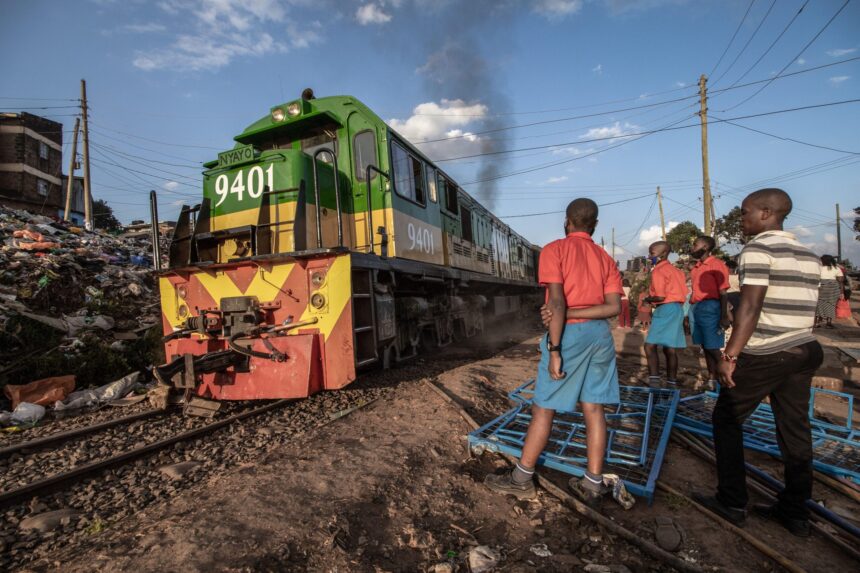
One of the high-profile tasks was the Mombasa-Malaba customary gauge railway (SGR) in Kenya. This concerned constructing a wholly new line parallel to its antiquated metre gauge railway which dates again to the Eighteen Nineties and runs at speeds of simply 20-35 kilometres an hour.
The primary sections of the SGR, price practically $5 billion, have been funded by means of concessional loans from the Export-Import Financial institution of China and accomplished between 2017 and 2019. However subsequent sections, together with an important hyperlink to landlocked Uganda, have been placed on maintain after Beijing determined to ease again on lending.
Following years of prevarication, China additionally determined towards funding Uganda’s SGR from Kampala to Malaba within the east of the nation.
The UAE is now being courted as a possible financing associate to finish Kenya’s SGR, which stops about 400 kilometres wanting the border with Uganda. In January this 12 months, throughout a go to to Abu Dhabi, Kenya’s President William Ruto introduced on social media platform X that he was exploring a partnership settlement with the UAE to finish the railway, which is deliberate to proceed on to South Sudan from Uganda.
Etihad Rail is the developer and operator of the UAE’s 900km nationwide rail community. Since its institution in 2009, it has pushed the greenfield building of an built-in system with full freight operations efficiently commencing in 2023 and passenger providers anticipated subsequent 12 months.
It’s attention-grabbing to notice that the MoUs inked with African ministers in Might emphasise technical co-operation and information change instead of any point out of financing – which tends to be their main concern. However there may be a lot that may be discovered from the UAE’s experiences.
One of many takeaways is that Etihad Rail devoted appreciable effort and time to safe multi-year partnership agreements with producers and logistics corporations to make use of its freight providers lengthy earlier than the community was accomplished.
For instance, in 2021, a deal was signed with Western Bainoona Group to move 4.5 million tonnes of aggregates a 12 months from Fujairah to industrial zones in Dubai and Abu Dhabi utilizing 643 trains. Etihad signed the same settlement with Ras Al Khaimah quarrier Stevin Rock for 3.5 million tonnes of building supplies to be carried to Abu Dhabi by means of 500 annual prepare journeys.
From the outset, the design of the UAE rail community additionally integrated intermodal infrastructure.
In contrast, Kenya’s new railway has suffered from lower-than-expected utilization for each passenger and freight providers which is making it troublesome to service the loans used to construct it, forcing the federal government to lift costs and terminate the SGR’s third-party working contract. The lacking connection to Uganda and poor intermodal hyperlinks have additionally being blamed for the railway’s underperformance.
Securing freight commitments and constructing stable enterprise circumstances for the railways forward of time as Etihad Rail did would make it simpler for African nations to lock in funding whereas additionally gaining a deeper perception into the particular necessities of future finish customers.
Liz Bains is a enterprise journalist protecting Africa and the Center East