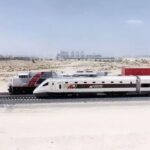

If any proof were needed that diplomatic and economic relations between Saudi Arabia and Qatar are back on track, the joint high-speed rail project between the two countries would be the best proof.
The agreement, which has just been signed in Riyadh, formalises an initiative by Saudi Crown Prince Mohammed bin Salmane and the Emir of Qatar, Sheikh Tamim bin Hamad Al Thani. It comes against a backdrop of several projects proving that the honeymoon is real between the two countries.
According to a statement relayed by the official Saudi press, a “high-speed electric railway line” will soon link Riyadh and Doha. It will be extended by a branch that will also connect the Saudi cities of Al-Hofuf and Dammam. All in all, this would create a rail link between several major economic centres in both countries. And it is likely that the Kingdom of Bahrain, along which the future high-speed line will run, will one day join the network.
In a press release, the Qatari Ministry of Transport (MoT) presented this initiative as a new corridor for fast, environmentally-friendly mobility, capable of transforming the travel experience within the Gulf.
The high-speed train route will cover 785 kilometres. It will mainly link the capitals of Doha and Riyadh, while serving several major regions. The network will also provide a direct connection between theHamad international airport in Qatar and the future King Salman International Airport in Saudi Arabia. This link will make travel easier, facilitate business exchanges and boost tourism.
Travelling at speeds in excess of 300 km/h, the train will cover the distance between the two capitals in around two hours. By comparison, a direct flight between Riyadh and Doha currently takes almost 90 minutes. The authorities anticipate that more than 10 million passengers will use the line each year, benefiting from simplified access to the two countries’ iconic sites. The project is also expected to generate more than 30,000 direct and indirect jobs.
In economic terms, this railway line is one of the most strategic initiatives in the region. The two countries anticipate a cumulative impact estimated at 26.1 billion euros (115 billion riyals) on their GDP, strengthening integration within the Gulf Cooperation Council thanks to a modern, interconnected rail network.
The work is expected to take six years to complete and will meet the highest international standards in terms of safety, quality and rail technology. Designed to be fully in line with regional climate objectives, the project will help to reduce carbon emissions and promote intelligent, sustainable modes of transport.