
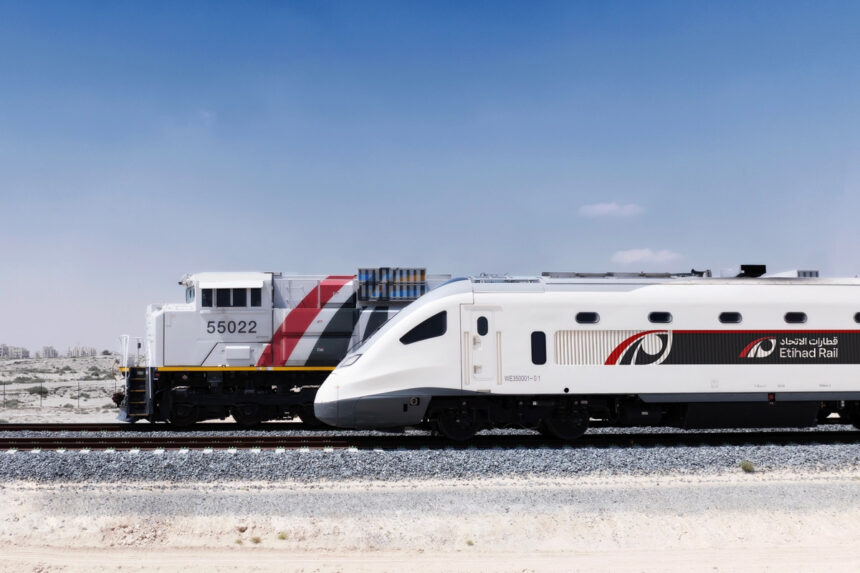
Think about stepping onto a practice that feels much less like a method of transport and extra like an extension of your every day life. That’s central to our ambition for rail right here within the UAE, the place we’re striving to create an expertise the place consolation, velocity and sustainability converge – the place expertise makes your journey seamless and time on board feels helpful, not misplaced.
This aspiration could really feel lofty, but it surely recognises that around the globe, passenger expectations of rail journey are altering at extraordinary velocity. The query going through Etihad Rail and Keolis will not be whether or not our partnership can rise to the problem, however how boldly our partnership will reply.
Railways have at all times been about greater than the sum of their infrastructure. They’re engines of connection – between folks, cities and economies. In at the moment’s world – the place the smartphone is as important as a ticket – passengers not choose a journey solely by punctuality. Our potential prospects anticipate rail to be versatile, digitally enabled, sustainable and human-centred. It needs to be oriented across the passenger and molded to the way in which they stay.
Think about this: by 2030, world passenger demand for rail is forecast to rise by nearly 50 per cent, in no small half pushed by a mix of urbanisation, inhabitants progress and the pressing strategic push in direction of low-carbon transport. Rail emits a small fraction of CO2 per passenger-kilometre in comparison with personal automobiles and planes, making it central to world local weather methods. Within the UAE, the place the inhabitants is projected to exceed 11 million by 2031, rail presents not only a resolution for mobility, however a pathway to shaping a extra linked, sustainable society. It’s one in all causes for Etihad Rail’s inclusion within the ‘Venture of the 50’ – a sequence of developmental and financial initiatives that purpose to speed up the UAE’s growth, and rework it right into a complete hub in all sectors.
Collectively, Etihad Rail and Keolis have been asking ourselves, what do passengers really need from rail within the twenty first century? The reply is strikingly constant throughout continents: velocity, reliability, and ease. The truth is, in keeping with the UIC-McKinsey report Boosting Passenger Desire for Rail (2022), 87 per cent of respondents indicated that reliability, velocity and comfort are amongst their prime resolution standards in selecting modes of transport. However equally necessary are much less tangible qualities: a way of dignity, consolation and confidence that their journey is a part of a much bigger dedication to group and planet.
It’s right here that you will need to single out the advantages of digital companies particularly – real-time updates, straightforward ticketing, personalised presents – that considerably enhance passenger satisfaction. In parallel, demand for greener selections is not area of interest. Based on the Worldwide Vitality Company (IEA), two-thirds of worldwide travellers now think about environmental impression when making transport choices.
From the outset, Etihad Rail and Keolis have been clear that expertise should not be an add-on – it’s the spine of the trendy passenger expertise. From AI-driven scheduling that reduces delays, to apps that permit passengers to plan, pay and personalise their journeys in seconds, rail is more and more outlined by digital innovation.
Sensible ticketing in Europe has reduce boarding instances, whereas predictive upkeep powered by AI has decreased breakdowns in superior rail networks. Within the UAE, the place connectivity and digital fluency are hallmarks of our society, rail companies might want to ship this similar seamlessness – the place each stage of the journey, from reserving to arrival, feels easy.
However expertise’s function shouldn’t solely be centered on comfort, it also needs to allow inclusivity. Passenger info methods tailor-made in a number of languages, step-free entry guided by digital instruments, and companies for folks with decreased mobility are all a part of redefining what it means to be passenger-first, and our partnership will depart no stone unturned in our efforts to discover how expertise may also help all passengers expertise the advantages of rail journey.
If expertise is the enabler, sustainability is the ethical compass of recent rail. It’s extensively accepted that transport accounts for almost 25 per cent of worldwide CO₂ emissions. Passenger rail is uniquely positioned to vary this trajectory. In France, as an example, the place Keolis is headquartered, laws now restricts short-haul flights the place an equal practice journey exists beneath 2.5 hours – that is itself a recognition of rail’s means to supply greener, equally environment friendly alternate options.
And for the UAE, sustainability is not only a coverage aim, it has develop into a part of a nationwide ethos. The dedication to realize web zero by 2050 locations rail on the coronary heart of the nation’s transition. Each passenger who chooses rail over a automobile or airplane contributes to cleaner air, quieter cities, and a extra resilient local weather future. That is the place partnership issues -combining world greatest apply with native ambition to create a rail system that’s each world-class and uniquely Emirati.
In the end, rail will not be about trains – it’s about folks. It’s a couple of commuter in Abu Dhabi who not should fear about driving forwards and backwards to succeed in their vacation spot. A pupil in Fujairah who can journey affordably to alternatives in Dubai. A household who chooses the practice as a result of it feels safer, cleaner, and higher for his or her youngsters’s future.
These tales will outline the success of passenger rail within the UAE and past. They remind us that infrastructure is barely as helpful because the lives it improves.
So, as Etihad Rail and Keolis embark on this new chapter collectively, we share a profound duty: to construct a passenger rail system that anticipates tomorrow’s expectations, not yesterday’s requirements. A system that blends expertise and sustainability, effectivity and empathy.
However this future will not be formed by operators alone. It’s a collective endeavour – of policymakers who prioritise rail in mobility methods, of companies who combine it into their logistics and workforce planning, and of passengers who embrace it as their first selection of journey.
The evolution of passenger rail is going on now. The chance is to make sure it unfolds in a manner that redefines not solely how we transfer, however how we stay.