
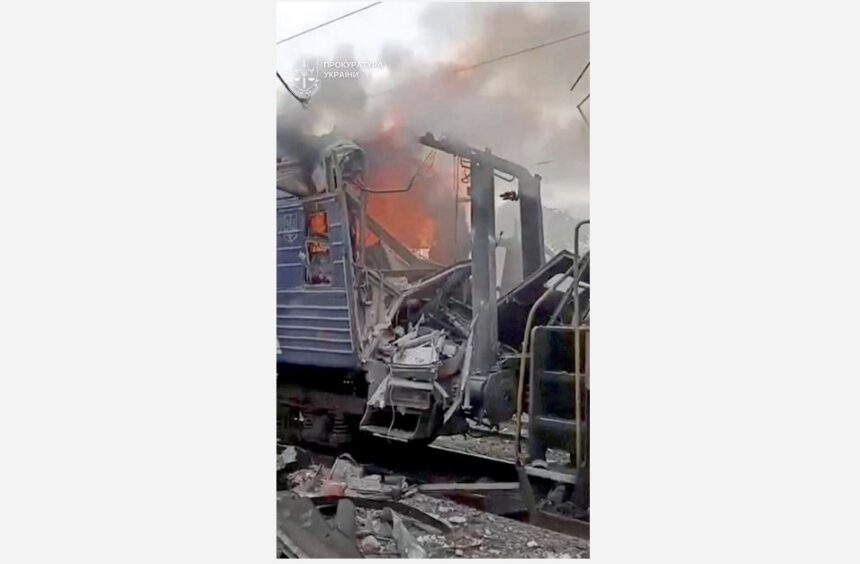
Two Russian drones struck trains at a station in Ukraine’s northern Sumy area, killing one particular person and injuring about 30 others, officers stated yesterday, with Ukraine’s international minister accusing Moscow of intentionally hitting passenger trains.
“A brutal Russian drone strike on the railway station in Shostka, Sumy area,” Ukrainian President Volodymyr Zelenskiy wrote on Telegram, posting a video of a wrecked, burning passenger carriage and others with their home windows blown out.
Ukraine’s international minister Andrii Sybiha accused Russia of intentionally conducting two strikes on passenger trains.
“This is among the most brutal Russian techniques – the so-called ‘double faucet’, when the second strike hits rescuers and other people being evacuated,” he stated in an announcement launched by his ministry on social media.
Sumy area governor Oleh Hryhorov stated eight folks had been taken to hospital.
“The Russians couldn’t have been unaware that they had been concentrating on civilians. That is terrorism, which the world has no proper to disregard,” Zelenskiy wrote.
Moscow has stepped up its air strikes on Ukraine’s railway infrastructure, hitting it virtually day-after-day over the past two months.
Russia has repeatedly denied concentrating on civilians in its conflict in Ukraine, though many hundreds have been killed by its navy.
In a video interview from a practice en path to the strike web site, the CEO of Ukraine’s state rail firm Oleksandr Pertsovskyi informed Reuters that the drones had focused locomotives, additionally damaging the carriages connected to them.
“In essence, they’re looking for locomotives,” he stated, including that Russia was more and more deploying this tactic.
He stated the trains hit had been an area commuter service and one other practice headed to the capital, Kyiv.
The rail chief added that there was solely civilian visitors on the station, and that he believed this was an try to make areas like Shostka, which is about 50km from the Russian border, unsafe for passenger visitors.
“They’re doing every little thing to make frontline and border areas uninhabitable, in order that individuals are afraid to go there, afraid to board trains, afraid to collect at markets, and in order that college students are afraid to return house.”